

BEYOND ENFORCEMENT: A COLLECTIVE STAND AGAINST COUNTERFEITS
- News and Events
- Hits: 744
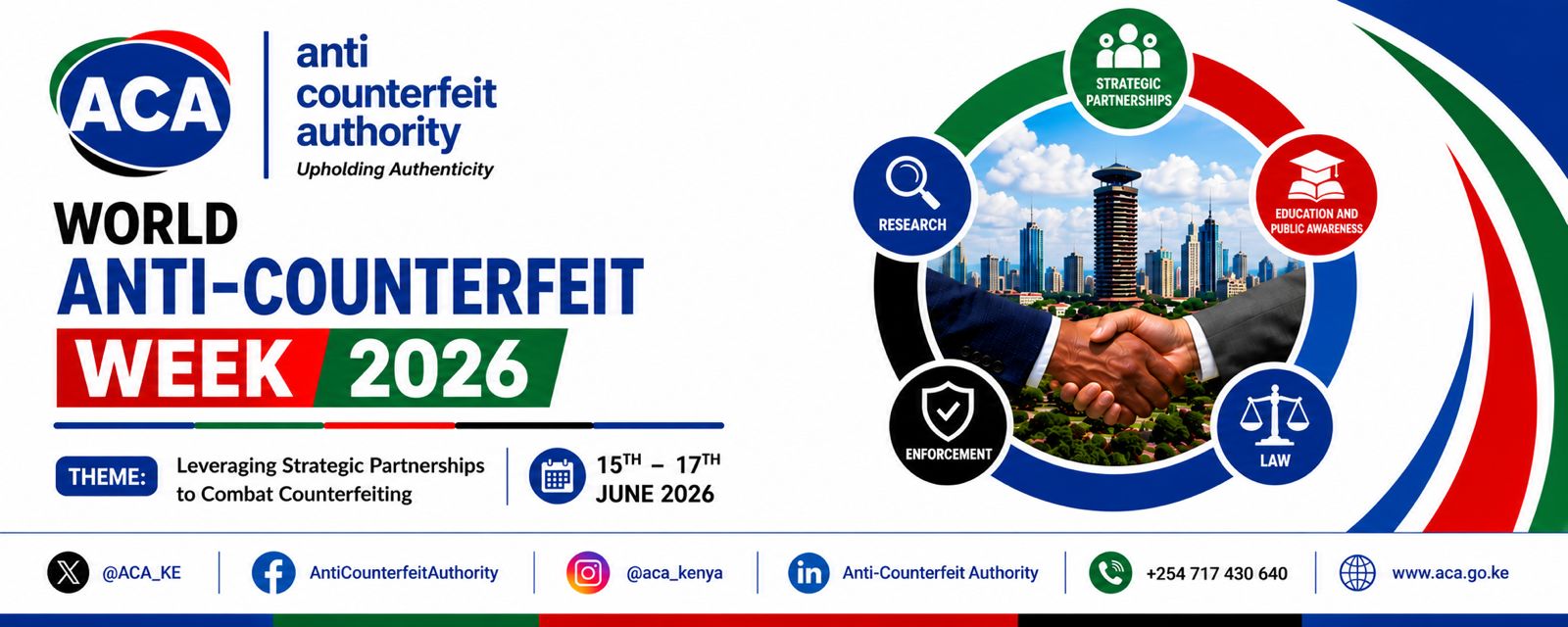
Counterfeiting can no longer be treated as a problem that enforcement alone can solve. It is a complex economic, consumer protection and intellectual property challenge that cuts across borders, sectors and institutions, and it demands a response of equal breadth. As the Anti-Counterfeit Authority commemorates World Anti-Counterfeit Week 2026 under the theme "Leveraging Strategic Partnerships to Combat Counterfeiting," the message is unambiguous: the fight against counterfeiting must be collective, coordinated and sustained.
The damage counterfeit goods inflict extends well beyond the businesses they imitate. They expose consumers to unsafe and substandard products, deny innovators the value of their intellectual property, distort fair competition and erode public trust in markets. Often consumers acquire these goods unknowingly, drawn by lower prices, easy availability or a finish that is difficult to distinguish from the genuine article. For this reason, public awareness is as central to the response as enforcement itself.
Confronting the problem therefore calls for a whole-of-society approach in which every actor carries a defined responsibility. Government agencies must work in concert to strengthen surveillance, border control, prosecution and market inspections. Rights holders are expected to support product identification, training and intelligence sharing, while traders and manufacturers uphold ethical business practices and consumers are equipped to verify what they buy and report what they doubt. Each role reinforces the others, and the system weakens wherever one is neglected.
Strategic partnerships also position institutions to adapt as counterfeiting evolves, particularly as illicit trade migrates onto digital platforms and conceals itself within increasingly sophisticated supply chains. No single agency can meet challenges of this scale in isolation. Collaboration builds stronger intelligence networks, faster response mechanisms and a more informed public, multiplying the reach of every institution involved.
World Anti-Counterfeit Week 2026 offers a timely opportunity to renew that commitment. It convenes enforcement agencies, industry players, innovators, consumers, academia and development partners to reflect on progress, exchange experience and refine practical solutions that can be carried forward beyond the week itself.
Building a counterfeit-free Kenya is, in the end, more than an enforcement objective; it is a national development priority. It safeguards consumers, advances innovation, sustains legitimate trade and underpins broader economic growth. Through strategic partnerships, Kenya can move steadily toward a market in which authenticity is valued, innovation is protected and the consumer is safe.